
At MicroLub, we understand that the pleasure of eating and the performance of personal care products begins with molecular friction. Our technology is rooted in the study of how surfaces interact at the molecular level to create the sensory experiences we perceive as creaminess, smoothness, and indulgence.
When we eat, molecules interact with our tongues and the inside of our mouths. This interaction – molecular friction – generates the sensory signals our brains interpret as texture and mouthfeel. High friction creates unpalatable, sticky sensations. Low friction creates the creamy, rich experience associated with fats and oils.
The same principles apply to personal care products, where friction determines how creams and lotions feel on the skin.
The challenge in New Product Development and reformulation? Removing fat/oil or adding protein dramatically increases friction, undermining mouthfeel and consumer acceptance.
MicroLub’s proprietary technology creates biolubricants that reduce molecular friction to deliver oil-like performance – but without the addition of a single drop of fat or oil.
Precision is critical. Too much polysaccharide coating, and the molecule behaves like a polysaccharide. Too little, and it behaves like a protein – resulting in the astringency and grittiness we’re trying to avoid. Getting the ratio right, with the specific architecture required, is the secret behind what makes our technology work.
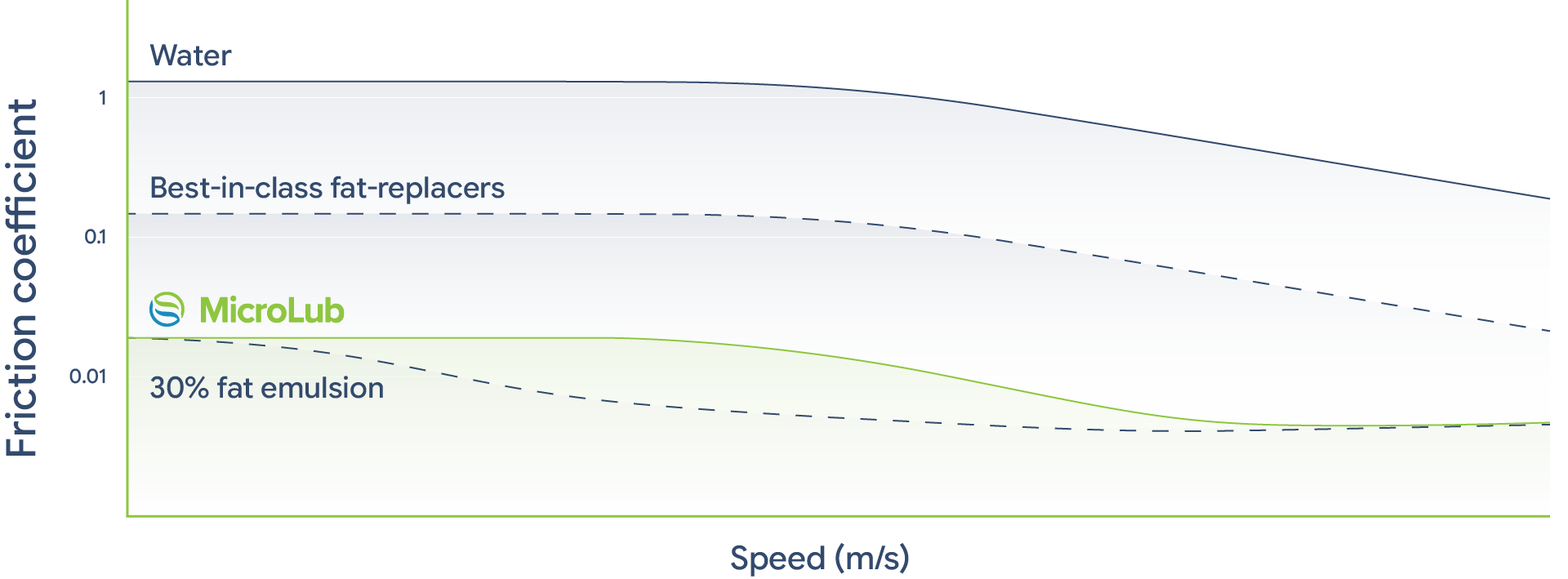

Our technology reduces molecular friction by two full orders of magnitude compared to water, and one full order of magnitude compared to existing, best-in-class fat-replacers. This brings friction down to the level more usually associated with oil – which is why products made with our technology solutions match the sensory experience of the originals.

Because our technology works with a wide range of commonly-used proteins and polysaccharides, we can create application-specific solutions tailored to your needs.
The choice of protein and polysaccharide depends on multiple factors:
This flexibility is why we’re an ingredient technology solutions provider, designing bespoke formulations for specific technical challenges.
A biolubricant is a naturally derived molecule that reduces friction between surfaces. In food science, MicroLub’s biolubricants reduce molecular friction inside the mouth during eating — recreating the smooth, creamy sensation normally provided by fats and oils, without adding a single drop of fat or oil to the formulation. In personal care, the same principle applies: MicroLub’s protein-based biolubricants reduce friction on the skin to deliver the silky, luxurious feel of conventional emollients, using naturally derived ingredients.
When we eat, molecules interact with the tongue and the surfaces inside the mouth. This interaction — molecular friction — generates the sensory signals our brain interprets as texture and mouthfeel. Low friction, as produced by fats and oils, creates the creamy, smooth, indulgent experience associated with premium food products. High friction produces the unpleasant grittiness and astringency that often result when fat is reduced or protein is added. MicroLub’s technology brings friction back down to fat-like levels, restoring the sensory experience of full-fat products in reformulated alternatives.
MicroLub’s technology creates biolubricants through a precise three-step process: first, protein scaffolds are formed from a toolbox of well-established dairy or plant-based proteins; second, these scaffolds are coated with polysaccharides (long-chain carbohydrates) in precisely calibrated ratios; and third, the resulting molecule functions as a microscopic lubricant that reduces friction to oil-like levels. Precision is everything: too much polysaccharide coating and the molecule behaves like a polysaccharide; too little and it behaves like a protein, causing the very same issues MicroLub’s technology is designed to eliminate.
MicroLub’s biolubricant technology reduces molecular friction by two full orders of magnitude compared to water, and one full order of magnitude compared to existing best-in-class fat replacers. This is a significant and measurable performance advantage: it brings friction down to levels normally associated with oil, which is why products made with MicroLub’s solutions genuinely replicate — rather than merely approximate — the sensory experience of full-fat originals.
MicroLub works with a flexible toolbox of well-established proteins — both dairy (such as whey protein) and plant-based (such as pea, potato, soy) — and polysaccharides (long-chain carbohydrates). The specific combination chosen for each application is determined by the end-use category (food, beverage, or personal care), cost and ingredient pricing, clean-label requirements, and supply chain considerations. This flexibility allows MicroLub to design bespoke ingredient solutions tailored to the specific technical and commercial needs of each customer, as well as more standardised formulations.
A protein microgel is a microscopic gel-like particle made from proteins. In MicroLub’s technology, protein microgels form the core structural unit of the biolubricant. When coated with polysaccharides in the right ratio, the microgel becomes a highly effective lubricant that reduces friction to oil-like levels. The architecture of the microgel — its size, structure, and the precise ratio of its polysaccharide coating — is what determines its performance. This proprietary architecture is the foundation of MicroLub’s competitive advantage.
Yes, absolutely. MicroLub’s platform technology is compatible with both dairy and plant-based proteins, giving the company the flexibility to design solutions that meet a wide range of dietary, clean-label, and sustainability requirements. For plant-based product developers, this is particularly significant: plant proteins typically cause astringency and textural problems, and MicroLub’s technology specifically addresses these challenges, enabling plant-based products to achieve a sensory experience comparable to dairy originals.
MicroLub is a spinout from the University of Leeds’ Sarkar Lab, one of the world’s leading research groups in food tribology (the science of friction in food systems) and food biophysics. The company’s core technology is built on years of peer-reviewed academic research into how proteins and polysaccharides interact at the molecular level to control friction. This rigorous scientific foundation — combined with MicroLub’s proprietary formulation know-how — gives the company a credible, defensible technology platform that is translated into practical, scalable ingredient solutions for industrial partners.
As a spinout from the University of Leeds’ Sarkar Lab, MicroLub translates years of peer-reviewed research and proprietary expertise into practical solutions. We work with partners across the food and personal care industries to deliver innovation backed by rigorous science.
The result? Products that are genuinely better for you, better-tasting, and better for the planet.