

The term ‘healthy and sustainable diet’ is used widely, with a common understanding that we should all be transitioning towards a diet that is plant-rich, meets our recommended five-a-day, and contains a range of protein sources including beans and pulses. 1
This eating pattern broadly aligns with the UK Eatwell Guide, as well as dietary recommendations in many other countries.
Retailers have also made commitments to help shift customers towards healthier baskets, aligning with the Eatwell Guide.2 This is where we need to get to, for the improved health of both people and planet.
But with less than 1% of us meeting all nine Eatwell Guide recommendations what is the journey to get there? 3 And, in particular, how do we address all the foods and products that aren’t even on the Eatwell Guide plate?
What about what isn’t on the plate?
In the bottom left corner, next to the plate, there are examples of the foods and drinks that the Government says we should eat ‘less often and in small amounts’. 4
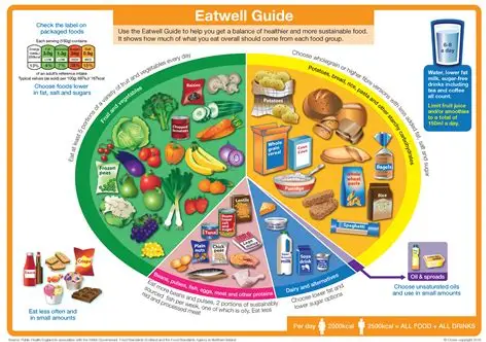
I’m sure most people would agree, but with 47% of energy consumed coming from foods high in fat, salt or sugar (HFSS) according to an analysis of the National Diet and Nutrition Survey, this guidance is clearly not translating into behaviour.5
The reality is that people are not simply going to stop buying desserts, ice cream, confectionery and biscuits. And asking people to switch between categories, for example, picking up an apple instead of a chocolate bar is not as straightforward as it sounds.
Food choices are influenced by the occasion, the need and the shopping mission. IGD’s work on shopping missions highlights the importance of understanding what shoppers are trying to achieve at a particular occasion, and how this influences the products and categories they consider. 6
If someone is looking for a treat, they are looking for a particular eating experience. An apple may be a healthier choice, but it isn’t necessarily fulfilling the same need.
Perhaps we shouldn’t focus solely on persuading people to move from one category to another. What if we could make the foods people are already choosing better, and this is where reformulation could play an important part.
Alongside encouraging healthier food choices, there is an opportunity to improve the nutritional profile of the products consumers already enjoy. For manufacturers, the challenge is to reduce fat, sugar or salt while preserving the taste, texture and mouthfeel that make those products appealing, therefore not just making a product healthier, but making a healthier product that consumers still want to buy.
The Food and Drink Federation’s recent work highlights some of these challenges, with manufacturers reporting products being rejected by consumers, pulled from shelves or, in some cases, returning to the original recipe. Only 13% of companies surveyed reported that healthier innovation projects had a consistent positive impact on profitability. 7
Taste and texture aren’t a nice-to-have. They are fundamental to whether reformulation can actually deliver change at scale.
But what if we could significantly improve the nutritional profile of an indulgent product, reducing fat and saturated fat and lowering calorie density, all without asking consumers to compromise on the eating experience?
This is where advances in formulation technology could make a real difference.
If we can use familiar, everyday ingredients and new approaches to reduce fat while maintaining the sensory characteristics consumers value, the product doesn’t even have to be positioned as a ‘healthier alternative’, it can simply be a better version of the product people already want. And this could genuinely be a huge opportunity.
The discretionary food category may not be on the plate, but it isn’t going away anytime soon.
Reformulation, supported by advances in ingredient technology, offers an opportunity to improve the foods consumers already enjoy while preserving the eating experience they value. Alongside encouraging healthier dietary patterns, this could help make better nutrition more accessible without placing all the responsibility on consumers.
Sources:
[1] British Nutrition Foundation. Eating sustainably / Key facts about a sustainable diet.
[2] Examples include Sainsbury’s and Lidl commitments on healthier and more sustainable diets.
[3] Scheelbeek et al. (2020), as summarised by the Rank Prize and subsequent UK dietary-gap research. Less than 1% met all nine Eatwell Guide recommendations.
[4] UK Government. The Eatwell Guide and Resources. Foods high in fat, salt and sugar are advised to be consumed less often and in small amounts.
[5] Kesaite et al. (2025). Overlap between ultra-processed food and food that is high in fat, salt or sugar: analysis of 11 annual waves of the UK National Diet and Nutrition Survey 2008/09–2018/19. BMJ Nutrition, Prevention & Health.
[6] IGD (2026). How missions shape shopper choices and Think mission first to understand shoppers.
[7] Food & Drink Federation (2026). Shaping a healthier nation